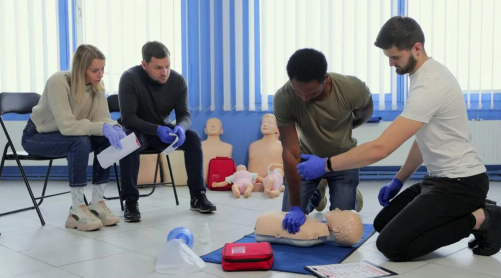
Life becomes a series of endless ‘what-ifs’ when you are stuck in a spiral of guilt and missed opportunities. While this is a universal experience, several people choose to learn from their mistakes— making each moment count.
Keeping note of that, emergencies should never be taken lightly. It doesn’t matter if it’s about people suffering from sudden cardiac arrest or having an obstructed airway. If you don’t act on time, an obstructed oxygen supply can lead to permanent brain damage within a 6-minute window.
Despite first responders doing their best, even the slightest delay in performing CPR can lead to life-threatening outcomes. Whether the moment is for making someone smile or to save a life— hesitation no longer remains an option. For this reason, many choose to do a BLS CPR instructor course in Dallas— to maximize the impact of bystander CPR availability.
Keep reading to know more.
Why You Should Consider a BLS CPR Instructor Course In Dallas
Anyone who wants the best for their community by making a lasting difference would be motivated to be well-practiced in BLS CPR. Considering how any course is a choice rising from interest, there’s something profound about becoming a BLS CPR instructor.
Unlike other skillsets, a BLS CPR instructor course actually allows you to create a ripple effect of lifesaving instances in society. Just think about this yourself. By teaching masses over a period of time, you’ll increase the chances of bystanders having the skills to perform CPR.
So when the need arises, they’ll leverage their skillset and make the best out of the situation. Reputable training institutions— such as CPR Training Clinic— second this idea of bystander CPR providers impacting society by increasing the chances of survival.
How the Data Supports the Need for Bystander CPR
The cornerstone for BLS CPR’s need in Dallas lies in what the data indicates so far. If you take a closer look at the numbers, then you’ll see how less than half the population of Dallas suffering from out-of-hospital cardiac arrest (OHCA) actually have access to the help of bystander CPR.
Similarly, more than half of the population of OHCA cases (in Dallas) do not have access to first aid, CPR, or AED devices— administered by a bystander.
Noting how this is an alarming indication, you need to strategize how to maximize your impact. It is precisely due to this reason that enrolling in a reputable BLS CPR instructor course in Dallas makes the process worth the time & effort.
Not only are you able to educate the masses with precision, but you also save lives through an indirect channel.
What Do BLS CPR Instructors Actually Do?
The work of BLS CPR instructors is seamless and smooth— given that they’ve adequate expertise & certification to back them up. They are required to function under the guidelines of specific healthcare organizations to meet industrial standards. These include:
- The American Heart Association (AHA),
- The American Red Cross (ARC), or
- The Health Safety Institute (HSI).
Though when these individuals complete their BLS CPR instructor course in Dallas, they automatically gain recognition. After all, their BLS CPR instructor certificates are accredited/recognized by either of these organizations. So, it only makes sense for their reputation to be reliable.
As you tick the box of legitimacy, you can now proceed with understanding what BLS CPR instructors actually do.
See also: Ztec100.Com Tech – Discover Tech Solutions and Innovations From Ztec100
Key Responsibilities of BLS CPR Instructors
- Lead in-person sessions
- Record video-guided lessons
- Deliver lectures
- Demonstrate the use of an AED & a First Aid kit
- Facilitate hands-on practice (for CPR)
- Evaluate skills
- Test the proficiency of students
- Maintenance of manikins & other supplies
- Manage paperwork
- Issue certification
Beyond these responsibilities, BLS CPR instructors are required to keep updating their information as time passes. The same is true for healthcare professionals who integrate relevant findings and techniques to simplify the chain of survival.
Speaking of which, it isn’t just healthcare professionals who can enroll in this course.
Who Can Enroll In This Course?
- Healthcare professionals → nurses, physicians, paramedics
- Emergency responders → police, firefighters
- Safety officers → at workplace, educational institutions
- Community benefactors → to teach quality BLS CPR to community members
- BLS CPR providers → proficiency can make you an instructor
In the end, the problem isn’t even about learning resources. What demands attention is the lack of willingness among the general public to deliver bystander CPR. If enough people enroll in a BLS CPR instructor course in Dallas, they can easily spread awareness about it. As a ripple effect, this can increase the number of bystander CPR providers in emergency situations.
Emergency Situations & the Impact of Bystander CPR
Only a timely response can save a victim from reaching unfavorable outcomes. Sitting around, surrounding the victim, and waiting for emergency services to arrive is quite useless. Wouldn’t you want a trained individual to emerge from the crowd and save the day?
Of course, in an ideal world, everyone would want that. Though if your love for humanity gives direction to your actions, then you can put it to good use. So, give the BLS CPR instructor course in Dallas a go, and save lives— one student at a time.
Considering the effect of a bystander CPR provider in an emergency situation, take a look at this table. It entails what you can expect from a typical emergency situation in the presence of a bystander CPR provider.
| Emergency Situation | Scenario | How Bystander CPR Helps | Expected Outcome | |
| 1. | Cardiac Arrest | A middle-aged man collapses in a cafe; he complains that he’s experiencing pain in his left arm; he gradually becomes unresponsive; his breathing pattern is abnormal | Delivers chest compressions This process pumps the blood to the brain and heart It keeps the victim from suffering irreparable brain damage | Raises the chances of survival by ≈ 30% |
| 2. | Drowning | A child drowns while going for a regular swim; an individual with certification of a BLS CPR instructor course in Dallas finds him, the victim is unresponsive; his breathing is obstructed | Provides oxygenDelivers hygienic & mediated rescue breathsTurns the victim on the side to clear the airway (enabling vomiting)Dries out chest to use AED (if needed) | High chances of recovery and prevention of brain damage; effectively restores oxygen and stabilizes the heart rate |
| 3. | Choking | A teen girl chokes on a chunk of candy; she coughs; she becomes unconscious; her breathing is obstructed | Provides oxygenDelivers air into the lungs Maintains circulationAttempts to clear the obstruction (if having expertise) | Restores oxygen supply to vital organs |
| 4. | Electric Shock | A young adult accidentally gets electrocuted by a bare wire during rain; his heart either stops, slows down (bradycardia), or goes haywire (tachycardia) | Assesses the safety levels of the scene (ensures power is turned off with the help of an insulating medium)Taps on the shoulder to check responsivenessDelivers 100 to 120 compressions per minute Provides two rescue breaths at the interval of every 30 compressionsTreats burns (if any) | If CPR is administered within the initial 4 minutes of shock impact, then the chances of survival increase significantly |
| 5. | Drug Overdose | An adult recovering from an injury unknowingly consumes a higher dosage of pain-relieving opioids; they’re found unconscious; their breathing is obstructed | Shouts at the victim (to evoke any sense of responsiveness)Shakes the victimPerforms a sternum rub (using the pressure of knuckles on the chest)Administers Nalaxone (in injectable or inhalation form)Clears the airway Repeatedly delivers one breath with a gap of 5 seconds Performs traditional CPR (if unresponsiveness persists) | Prevents brain damage & cardiac arrest; gives ample time for the body to stall on survival until emergency services arrive |
Maximize Your Impact Today
The impact of a BLS CPR instructor course in Dallas is evident after skimming through the variety of healthcare emergency scenarios. Though when it comes to it, saving lives is never about emerging as a lifesaver in the eyes of society. In fact, it’s more about your moral obligation to give maximum benefit to people in helpless situations.
Noting how dire the need for bystander CPR providers is in Dallas, it only makes sense that you maximize your impact by including the certification on your resume. So, educate individuals. Make them aware of the healthcare issues that can be easily tackled with timely responses.
To amplify the impact of your lifesaving journey, you can take the help of the CPR Training Clinic in Dallas. It’s a reputable institution, recognized by the American Heart Association (AHA), featuring a range of affordable pricing options and renewable licenses.
Want to get more info?