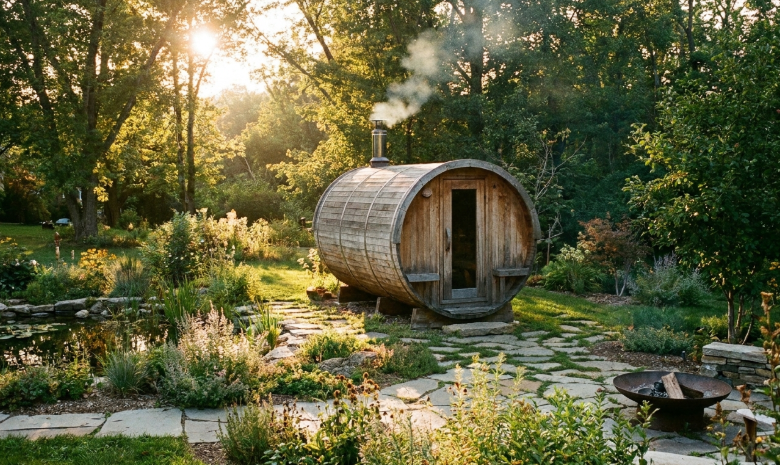
A barrel sauna and a cold plunge fit together in a small yard when placed roughly 10 to 14 feet apart including clearance, with a typical contrast sequence running 15 to 20 minutes of sauna heat at 170 to 190 degrees followed by 2 to 4 minutes of cold water at 50 to 59 degrees. The round barrel footprint and a compact plunge tub take up less combined space than most people expect, since neither needs the square footage a full cabin sauna or an in-ground plunge pool would.
What Contrast Therapy Actually Involves
Contrast therapy alternates hot and cold exposure in a single session, with the idea being that the swing between vasodilation in the heat and vasoconstriction in the cold creates a circulatory effect that either alone does not produce. In practice this usually means a sauna session followed by a short cold immersion, sometimes repeated for a second round. It is a popular home setup precisely because a barrel sauna and a plunge tub can both fit in a modest footprint, unlike a full spa-style hot tub and pool combination that needs far more space and plumbing.
How Much Space Two Units Need Side by Side
A 6-person barrel sauna typically needs about 8 to 10 feet of footprint once clearance for the door swing and maintenance access is included. A residential cold plunge tub, whether a stock tank conversion or a purpose-built unit, generally adds another 4 to 5 feet, plus a bit of room to step in and out safely without slipping on a wet surface. Positioned adjacent to each other rather than across the yard, the two units together can often fit in a space not much larger than what a single mid-size cabin sauna would need on its own, which is part of why this pairing works even on smaller residential lots.
A Sample Contrast Therapy Sequence
A common starting sequence is 15 to 20 minutes in the sauna, followed by 2 to 4 minutes in cold water, done once or repeated for a second round depending on tolerance and time available. Some people prefer a shorter first sauna round, closer to 10 minutes, before the first cold exposure, then a longer second sauna round afterward. There is no single correct pattern; what matters more is staying consistent enough to notice how your own body responds, and not rushing the cold step before you have built up tolerance over a few sessions.
Chiller, Gallons, and Filtration Basics for the Plunge Side
Smaller stock-tank style plunges commonly hold 100 to 150 gallons, while purpose-built units can range higher depending on design. A chiller keeps water at a consistent target temperature without relying on ice, which becomes impractical for daily use, and most residential chillers are sized to the tub’s gallon capacity rather than a flat wattage number. Filtration matters more than people expect for a tub that gets used daily, since standing water without circulation and a basic filter can grow bacteria within days; a simple pump and cartridge filter, or an ozone system for more consistent daily use, keeps water usable between full drain-and-refill cycles.
Electrical Planning When Running Both Units
A barrel sauna heater above roughly 6 kilowatts needs its own dedicated 240-volt circuit, and a plunge chiller typically needs a separate circuit as well, so budgeting for two runs from the panel rather than one is worth doing before either unit is ordered. Combining both into a single project quote with an electrician, rather than adding the plunge as an afterthought later, often saves on labor since the same trenching or wall penetration can sometimes serve both runs.
Safety Notes for Moving Between Extreme Temperatures
Moving from a hot sauna directly into cold water is generally safe for healthy adults, but it is worth doing gradually rather than rushing, since the temperature swing places real, brief stress on the cardiovascular system. People with unstable angina, a recent heart attack, uncontrolled blood pressure, or who are pregnant should check with a doctor before starting a contrast routine. A nonslip mat or step between the two units is a small addition that prevents the most common injury in a home setup, which is simply slipping on a wet surface while moving quickly between hot and cold.
What Does the Evidence Say About Combining Heat and Cold?
The cardiovascular research on sauna bathing is more established than the research on combining it with cold plunging. A large Finnish cohort study found regular sauna use, four to seven sessions a week, associated with lower rates of fatal cardiovascular events compared with once-weekly use, and a related study found sauna bathing jointly associated with lower mortality risk when paired with higher cardiorespiratory fitness. On the cold-water side, a 2025 systematic review and meta-analysis in PLoS One covering a broad range of cold-water immersion studies found the evidence for recovery benefits mixed, and some research on cold-water immersion specifically after resistance training has found it may blunt strength and hypertrophy adaptations rather than help them. That is a reasonable basis to separate hard training days from contrast sessions by several hours if maximizing strength gains matters, while still treating the sauna portion on its own as consistent with the broader cardiovascular research. Shoppers planning a combined setup and comparing a 6-person barrel against current sizing and pricing can check what is in stock alongside other specialty retailers before finalizing a layout.
Frequently Asked Questions
How much space do a barrel sauna and cold plunge need together? Roughly 10 to 14 feet of combined footprint including clearance, since a 6-person barrel needs 8 to 10 feet and most plunge tubs add another 4 to 5 feet.
What is a typical contrast therapy sequence? 15 to 20 minutes in the sauna at 170 to 190 degrees, followed by 2 to 4 minutes in cold water around 50 to 59 degrees, repeated once if desired.
Does cold plunging after a sauna session cancel out training gains? Cold-water immersion right after resistance training may blunt strength and muscle-building adaptations, so separate the two by several hours on heavy lifting days if that is a priority.
Do I need a chiller for the cold plunge side of the setup? Not strictly, but a chiller holds a consistent target temperature year-round without constant ice purchases.
Is it safe to move directly from a hot sauna into cold water? For most healthy adults, yes, done gradually. People with cardiovascular conditions or who are pregnant should check with a doctor first.
References
- Association between sauna bathing and fatal cardiovascular and all-cause mortality events, JAMA Internal Medicine, 2015
- Joint associations of sauna bathing and cardiorespiratory fitness on cardiovascular and all-cause mortality risk: a long-term prospective cohort study, Annals of Medicine, 2018
- Effects of cold-water immersion on health and wellbeing: A systematic review and meta-analysis, PLoS One, 2025
- Effects of cold water immersion after exercise on fatigue recovery and exercise performance: meta analysis, Frontiers in Physiology, 2023
By Trevor Lindqvist