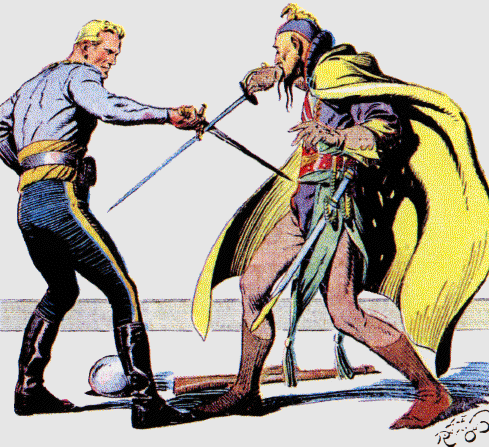
Great art is never just about heroes…
The shiny protagonist who comes in at the final hour and saves the day often gets all the applause – but it is the villain, the shadow at the edge of the frame, who gives the story its tension, its shape and its reason to exist.
In fact, in the 1980 film Flash Gordon, Max von Sydow’s Ming the Merciless exemplifies the modern “principled antagonist”: regal, terrifying yet strikingly logical.
Although the 1980s visuals may make him look a bit campy today, his pointed mustache and sharp robes hide a surprisingly logical and calculated approach to ruling the galaxy.
So, let’s examine 10 moments where Ming was, in fact, quietly correct.
Why People Still Love The Intergalactic Madness of Flash Gordon
Only a few people notice the villain. Most of the time, the hero grabs the glory, the cheers and the posters – but if you take a closer look, the villain is where the real intensity hides.
The same goes for Flash Gordon. The intergalactic chaos and fierce action may grab your attention, but it’s Ming the Merciless who gives the story its teeth.
Every calculated threat, every iron fisted decision and every icy yet calm stare tells a story about power, order and survival. These are the stories you might miss if you only focus on the flashy heroics.
Did you know? Max von Sydow reportedly refused to exaggerate his performance, insisting on a calm, authoritative tone to make Ming’s terror feel real. That restraint makes every scene with him feel chilling, showing that a true villain doesn’t need over the top theatrics to dominate the screen.
1. Testing Earth’s Worthiness
Ming’s decision in Flash Gordon to trigger natural disasters was less about cruelty and more about testing humanity’s potential. All he thought was, “If a planet cannot survive a few earthquakes and a red moon, are they really ready for intergalactic diplomacy?”
This was a step any prudent galactic emperor would take.
2. Maintaining Unification Between Kingdoms
By forcing the rival kingdoms of Mongo to pay tribute, Ming’s intervention created a centralized economy. Without him, Vultan and Barin would have spent centuries killing each other over birdseed and tree sap.
Did You Know? Max von Sydow’s costume was so heavy (nearly 70 lbs) that he could only stand in it for a few minutes at a time between takes!
3. Preparing for the Inevitable Boredom of Immortality
Immortality, as Ming experiences it, is a strange curse. That’s exactly why he thought a ruler who lives for centuries must face challenges to stay sharp. His “merciless” actions are a reflection of the boredom inherent in eternal power and a surviving skill – a lesson many would ignore.
4. Pragmatic Ultimatums
When Ming gives Flash an ultimatum, he is being transparent.
With these ultimatums, he lays out the terms of compliance clearly – a level of honesty rarely seen in modern politics.
5. Punishing Without Personal Bias
Unlike many rulers, Ming’s actions in Flash Gordon are never personal vendettas. They are guided by logic, pragmatism and a cold eyed assessment of what is best for his empire – even if it terrifies outsiders.
6. Dealing with Klytus
Ming knew his chief of secret police was a snake. By letting Klytus operate, he kept his enemies in check while keeping his own hands (mostly) clean.
7. Predicting the “Flash Gordon” Threat
Ming recognized immediately that a charismatic athlete could dismantle a thousand years of order. Viewers might think that he was paranoid; he was worried about the disruption of a discipline that had been going on since years.
8. Encouraging Heroic Growth
Heroes rise in response to a worthy adversary. By acting as the ultimate threat, Ming creates an environment where Flash Gordon, Prince Barin and others grow into their potential – an ironic nod to the necessity of a villain in storytelling.
Interestingly, this principle is still alive in modern sci-fi: films like Ivory Night at the Center of the Galaxy showcase shadowy antagonists proving that a story’s tension often lives in the villain’s actions.
9. Advocating Efficiency Over Sentiment
In a universe of scarce resources, Ming’s decisions are consistently efficient. He chooses outcomes that maximize order and minimize wasted effort, proving that sometimes emotion must be secondary to survival.
10. Preserving Galactic History
Through careful governance and selective conflict, Ming makes sure that the legacies of kingdoms endure. Without his interventions, Mongo might dissolve into chaos, erasing centuries of cultural, political and even technological achievement.
Did You Know: Ming’s costume designs influenced modern sci-fi villains like Thanos and Emperor Palpatine.
See also: Jaalifestyle Com Login – Log in to Jaalifestyle for the Latest Lifestyle Tips
Ming’s Influence in the Modern Era
| Modern Villain | Traits Borrowed from Ming | Notable Work |
| Thanos | Calculated extremism, sense of “necessary order” | Avengers: Infinity War |
| Magneto | Logic driven actions and moral ambiguity | X Men Franchise |
| Emperor Palpatine | Control through fear and strategic manipulation | Star Wars Saga |
Ming’s influence persists in how modern directors approach complex antagonists, favoring moral grey zones over simplistic evil.
He taught us that a villain is most terrifying when they believe they are the hero of their own story – a lesson Flash Gordon cemented decades ago.
What Future Has in Store for Villains
As cinema continues to see the story of villains with depth, the new era promises films that honor Ming’s legacy shown in Flash Gordon: morally complex antagonists, retro-inspired visuals and narrative ambition. And not to forget, upcoming titles like Ivory Night at the Center of the Galaxy show that audiences are hungry for stories where grey morality drives the plot, not just flashy heroes.
By revisiting Ming the Merciless, we’re reminded that villains aren’t merely obstacles that heroes need to fight – they are the architects of drama, tension and imagination.
In the end, perhaps Ming wasn’t just merciless; he was right, in his own formidable way.
If you want to watch more movies like Flash Gordon, explore Ivory Night at the Center of the Galaxy and see how Ming’s shadow still shapes modern storytelling.